The Game of Capitalism
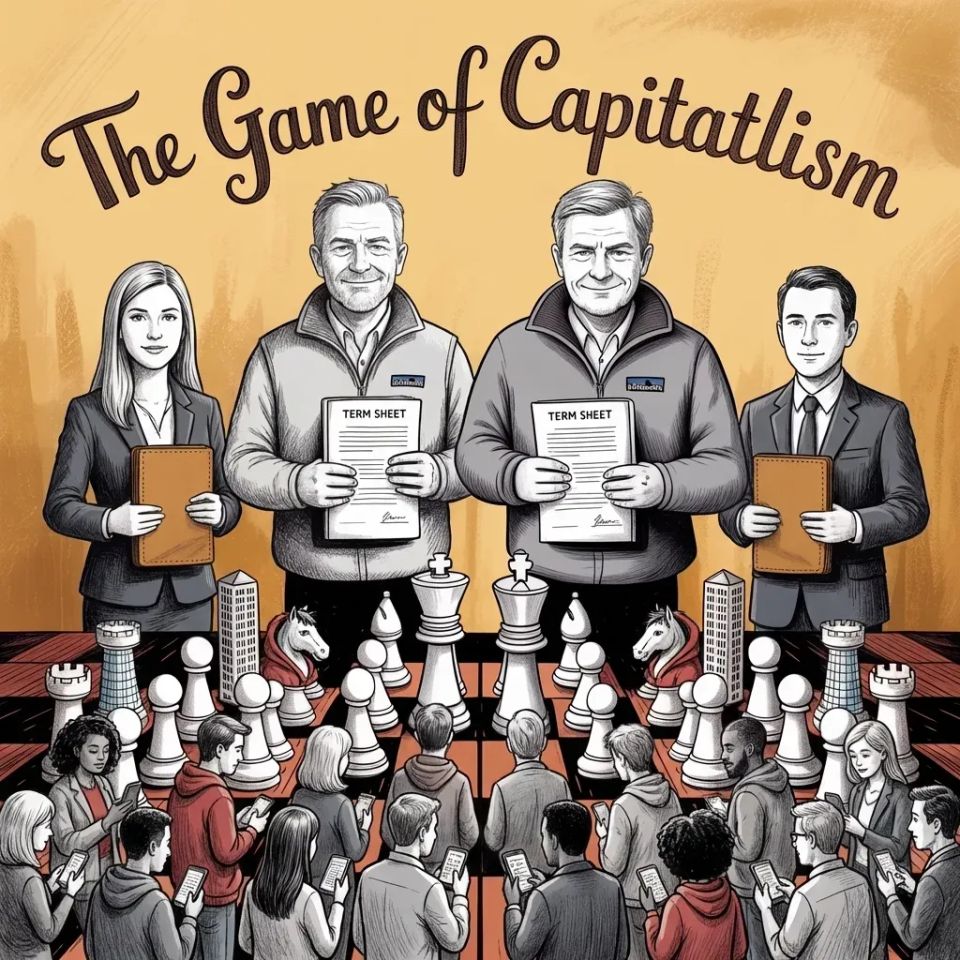
Summary: This essay defines the game of capitalism: the values that underpin the game, the key players, and the trade-offs between them.
It's a descriptive summary from a committed capitalist of how the game gets played today. I have spent enough time in closed rooms with the key players – investors, C-suite members, etc. – to know that what follows is an accurate description of how the game is played at the highest level.
This game design becomes more encoded into the game patterns every year, even though some power players don't play by it. Future essays will explore how technology works as a powerful, long lever to entrench this design into the game.
Readers familiar with how the system works can skim or skip the first two sections. Go straight to “Trade-Offs.”
[Our Four Economic Identities – Players in the Game]
Economic life is much easier to understand when we think of capitalism as a strategy game with four role players. They are: (1) asset and business owners, (2) workers, (3) consumers and (4) taxpayers.
Role players interact not just as external parties but also as identities within us. So the game gets played on two levels: interpersonally and inside our heads.
(1) Asset owners: This is a hidden role for most of us. 62% of U.S. households own stocks – making us passive, almost invisible business owners. [1]
Most of us rarely think about our role as owners. The transition from concentrated capital ownership in closely held corporations to broader mass ownership in public companies is a recent phenomenon. A century ago, in 1928, only 3% of U.S. households owned public equities.[2]
The real broadening out of equity ownership was achieved after 1980, through ERISA (“Employee Retirement Income Security Act”) regulation in the mid-1970s that allowed workers to defer portions of their paychecks (without paying income tax) into retirement accounts where they could invest in publicly traded bonds, equities, etc. This regulation broadened household ownership of equities over the next two decades.
But over 90% of the value of U.S. equities is still owned by the top 10% of households.[3] Those households tend to pay much more attention to their role as owners – follow their lead.
(2) Workers: About two thirds of working age Americans choose to work. Most of us live off our incomes and consider our job our central economic identity – even if we are not always strategic about it.
(3) Taxpayers: Most of us are taxpayers too. Around 60% of U.S. households pay income taxes on wages earned (in addition to many other taxes).
(4) Consumption: The consumer is the universal role. We all consume – from birth until we die. Consumer spending is the lifeblood of the U.S. economy: it’s worth $20T annually and drives nearly 70% of U.S. GDP.
[How The Game Works: System Design, Incentives & Rules]
“There is one and only one social responsibility of business… to increase its profits so long as it stays within the rules of the game, which is to say, engages in open and free competition without deception or fraud” ~ Milton Friedman, Capitalism and Freedom (1962)
In libertarian articulation the motivation of a capitalist free market society is to preserve individual liberty. Beyond that, motivations are left to be distributed down to individuals. More simply: the system is designed to protect freedom, not to produce “good outcomes” for society’s members. That this organizing system has proven best at increasing the material prosperity of its members (the consumers) over time is a happy byproduct. “Good outcomes” are not the goal. In the past half century, Milton Friedman has been the most persuasive champion for this line of thinking.
Economists measure The Game’s outcomes through change in Real GDP per Capita. That’s the total market value of all goods and services that the economy produces divided by the number of members (consumers). It is a proxy for material living standards.
In the last century it has become the north star performance metric for judging the effectiveness of The Game of Capitalism as an outcome generator. It may be widely debated and criticized, but no other metric has emerged to overtake it as a north star.
In The Game of Capitalism, each role player is focused on himself and his own motivations. Interlocking incentives lead the players to collaborate and serve one another.
Businesses are the engines of capitalism. Owners provide capital to businesses. In exchange for capital, they get control of the engines. Businesses compete against one another for profits by offering products and services to consumers. They try to win growing share of the consumers’ wallet while minimizing costs they incur to do so.
In practice – at least at large publicly traded companies with many anonymous shareholders – the actual running of the company is outsourced to managers. The task of maximizing profits goes to executives and Boards of Directors that work on behalf of (mostly anonymous) shareholders.
Save for maybe the private equity industry, there is no other group in modern capitalism that has embraced Friedman’s doctrine of “profit maximization as the purpose of a business” as thoroughly as the executives and Board members of blue chip public companies. Friedman is the patron saint in the stained glass of the Boardroom window.
There is healthy debate over the tactics and time horizons to which businesses should apply to Friedman’s doctrine. Many Boards and executive teams screw it up royally. A large portion of public companies get run into the ground by feckless managers and unengaged Board Directors who are just there to collect paychecks. But these tend to be companies that are too small and weak to capture a critical mass of attention from stock pickers. The executives and Boards of The Game’s biggest and most important companies cannot get away with straying from Friedman’s doctrine too far for too long. They work under the brightest lights in the market, where it is much harder for malfeasance to hide.
Consumer spending is the fuel that the engines run on. It is main input to overall corporate profitability. Consumption itself only accounts for ~70% of the U.S. economy but all the other components (government spending, business-to-business spending, etc.) are ultimately contingent on consumer spending.
To increase profits firms must offer enough value to consumers to entice them to part with their money. The whole process of winning wallet share from the consumer is supposed to be a dogfight. Standard theory says that economic profits of firms should go to zero eventually. In the textbooks excess profits get competed away by copycats. Basically all the value ends up accruing to the consumers.
Without consumption businesses have no revenues to pay their workers or their suppliers. No tax receipts to pay the government. For this, the consumer is sacrosanct in economic theory. The whole point of the corporate strategies that executives and Boards devise for profit growth is to get the consumer to spend (and presumably, make him happy).
In the Game of Capitalism, the consumer is supposedly the ultimate arbiter of value. The whole system design breaks down if his welfare is not delivered.
What role do workers (labor) and technology (capital) play? The game is not designed to serve the workers – workers must justify their own existence in the game. They are free agents. They are there to assist the executives and the Boards in maximizing long-term profits at the firms they run. To hold a job and a wage, a worker must prove his usefulness in fulfilling the profit maximization mission.
When executives and Boards find new means (e.g., technology) to serve their consumers that don’t involve labor, they eventually pursue them. Technology is a form of capital and the process by which technology replaces labor is called automation.
As workers’ tasks get automated they must find new ways to make themselves useful to remain in the game and keep earning wages. Businesses automate to increase profits: either by saving costs, growing quantities sold, improving quality, or all three.
While each individual business is incented to automate if doing so will grow profits, collectively business owners need the national workforce to remain employed. Without jobs consumers have no wages to fund consumption. Friedman’s archetypical business owner wants everyone employed – but ideally on someone else’s payroll.
The government has a monopoly on violence, taxation and money printing. It uses these powers and tax proceeds to ensure that the law is followed. To defend the private property rights of individuals and enterprises. To provide essential goods that private enterprises may not provide to all citizens – schools, national defense, roads and transportation infrastructure.
Like a referee, the government tries to manage the game around the edges. It looks to detect bad behavior and fine or imprison economic actors that do not play by the rules. It adjusts the money supply to manage inflation and employment opportunities. It raises money explicitly to redistribute income and wealth from high earners to low earners (e.g., programs like Medicaid and SNAP) or from young workers to retirees (Social Security).
The government does not get much airtime in my writings on The Game of Capitalism. But it is still the most powerful and flexible actor in the system because of its monopoly control over violence, taxation, and money. These controls give the government license to flex up and down its involvement in the game and the system over time.
The game of capitalism may sound brutal in this abstract take. Not every self-proclaimed capitalist would endorse it. And some owners do ignore the game design. There are plenty of owner-operators who run their companies with employee and community welfare in mind, not just profits.
But the game is not a benevolent system. It is fundamentally designed to run on competition, not compassion. The people running the game – CEOs of big, successful companies, big private equity funds, public equity asset managers, etc. – play according to the Friedman doctrine. Experience with them in closed rooms taught me that.
The proxy statements of public companies confirm it. These disclose the incentive-based compensation packages of executive officers and the company performance metrics that drive them. 90%+ of CEOs have compensation packages tied to profit metrics and/or relative stock price performance. For the people running the game, the Friedman doctrine is not an abstraction. It is woven into the contract.
Over the industrial era, the system has mostly worked as a good outcome generator. Individually rational players and well-aligned incentives between them lead everyone, as if by an invisible hand, to a better outcome than central planning by the government. This was the main idea of The Wealth of Nations, Adam’s Smith’s foundational text of modern economics. It is still the core bet of capitalist societies today.
[Tradeoffs: How Our Identities Interact Within Us, How We Interact with the System]
The beauty and motivation of modern capitalism is the freedom it affords each member in the game. The tragedies lies in how few members really understand the rules and mechanics of the game.
Market defenders argue vaguely that Americans should have “faith in the system.” Cynics rant about regulatory capture, victimization and predation. Through that unproductive cacophony, no one is clearly laying out how the game works.
So most of never understand how the game gets played. Or how our internal economic identities compete amongst each other in the game. We wind up underestimating the degrees of freedom each of us has within it.
Let’s say, reader, that you are in the majority – one of the game’s productive players that owns some stocks, holds down a job, buys stuff, and pays taxes to the government. That makes you a business owner, a worker, a consumer and a taxpayer.
Your inner business owner competes with your inner consumer. The owner wants you to save more of your paycheck to invest in greater ownership. But doing so means consuming less today.
Your inner worker competes with your inner consumer too. Working more hours placates your inner owner (by providing more income to invest). But at the cost of less time to buy stuff or experiences (frustrating your inner consumer).
Your inner owner may seem aligned with your inner worker. But they are treated very differently by the taxman and eventually collide. As you become more productive as a worker, you should (in theory) get paid more. As your wages raise, the taxman leans in on you. He takes a higher share of your wages.
As the weight of the taxman tires you out, your inner business owner starts to beg your inner worker to ditch the W-2 payroll and start a business directly. Owners have more options to optimize their time and tax payments than workers do.
Across this running monologue inside your head, different voices are hemming, hawing, and jostling for your agency.
So – who do you listen to? Without self-awareness and a clear game strategy, the voice that prevails inside most of us is the one that gets amplified most by the outside world.
If you are a good employee, your employer will probably tell you to work more. But aside from that most of the other parties in the economic game (collectively, “The System”) appeal to your inner consumer.
Businesses advertise to get you to spend your money with them. Other consumers consciously and subconsciously also entice you into spending. We are all mimetic and feel the pressure to keep up with the Joneses. The internet expanded your universe of Joneses from your neighborhood and community to whoever its algorithms put into your social media feed.
The preference and strategy of the powerful players in the game is to get the other players to consume – your inner consumer is the fuel that runs their engines. So we are constantly being pitched on reasons to buy and transact. Put differently – we are pitched reasons to ditch non-monetary activities for monetary ones.
Why stay in and Sabbath on Sunday when you can enjoy an easy meal at a restaurant? Why volunteer to coach Little League when the time commitment could cost you precious hours to climb the ranks at work? Instead of coaching, why not reinvest your higher salary in a new $500 bat at Dick’s and a spot for your son on the more expensive travel team? Why stay at home to raise your kids when you can get a good job that will produce more than enough income to pay a nanny or various care providers to do it for you?
Why drive to pick up your take-out food when you can pay some poor Door Dasher to bring it to your apartment? Why eat healthy and exercise when you can take a GLP-1? Why slow down your life to get your head right when your costly insurance plan will cover the expense for you to go see a shrink and get a prescription happy pill?
The structural logic of economically oriented societies is to fold ever more activity inside economic transactions. This isn't a conspiracy – it's emergent from the game's rules.
The powerful players – business owners and the government – benefit from consumption. Revenues and profits go up - so do government tax receipts. So every player is constantly pitched consumption. As this mechanism plays out over and over, and as consumers respond to the sales pitches, more human activity gets recorded as GDP. This is not accidental; it’s the exact outcome the game is designed to produce.
Early Christian culture subsumed fading pagan traditions and transformed them into high holy feasts that anchored and oriented the culture around God. The Roman festivals of Lupercalia became Valentine’s Day. The civil holiday of Sol Invictus and the festival of Saturnalia were replaced with Christmas.
Modern economic culture does the opposite. It is on a slow and devastating march to crowd out the sacred and replace it with the profane through the mechanism of the transaction.
Midnight Mass gets replaced with “Happy Holidays” cards featuring the year’s best family photos (from mom’s Instagram account). It’s a better mimetic marketing campaign than any travel marketing officer could have wished for. Saint Nick becomes Santa Claus. The nucleus of the season moves from Nativity scenes to Macy’s to Amazon delivery trucks. In October Amazon and UPS issue press releases indicating how many seasonal workers they intend to hire for the “Holiday Season” – to signal confidence to investors in the spending bonanza ahead. Hedge fund analysts crunch real time credit card data over Thanksgiving weekend to figure out which retailers are seeing the most demand growth and will have their stocks trade up into the New Year.
And it works. One-third of American families take on credit card debt to fund holiday gifts – outstanding balances typically rise 3-4% from October to December. To boot, the mechanism even tacks on an additional financial transaction (late interest payments) in arrears.
Through all this, the north star performance metric used to measure game outcome quality (real GDP per capita) keeps going up. The economization of life is an enduring tailwind for real GDP. The game is designed to crowd out everything non-economic – this crowding out moves its north star metric in the right direction.
If you don’t understand this basic mechanism, you will never see advertising pitches for what they are. You will never become aware of all the freedom that a capitalist society affords you. You’ll be a pawn in the game. What chess player wouldn’t want to compete against a bunch of pawns?
The Game of Capitalism can be fun and rewarding. It affords a lot of freedom with many paths to victory. But understand it for what it is: a game with winners and losers. Capitalism is not designed to take care of you or your family. You need a thought-out strategy and discipline to execute it to find your own path.
[The Limits of Economic Incentives]
As articulated by the Friedman doctrine, the modern Game of Capitalism is unapologetically selfish. And yet the historical record is clear. It works better than any other social organizing mechanism to provide material comfort and unlock human ingenuity. It does this appealing to nothing beyond freedom.
Yet economic incentives alone give us no good reason not to cheat, commit fraud, cut corners or generally screw over others in the pursuit of our own ends. In theory threat of violence and imprisonment from the government coerce us into fair play.
Yet libertarian types are right to distrust a big government as a backstop. It can’t effectively enforce every wrongdoing and is vulnerable to corruption. Even when the law is clear, the “rules of the game” are gray. Grayness invites negotiation. Negotiation invites opportunism. The Supreme Court passes Citizens United and The Chevron Doctrine. Food companies define the food pyramid, then sell you junk. Central bankers leave public service and go run private equity funds. Pharma executives “pivot” mid-career to run government health agencies. The game gets full of player referees.
In some 3-D version of this chess game, awareness that the whole system will break if enough people violate the first order incentives to pursue selfish interests only within the rules maybe is sufficient to keep people from violating them. But this is what economists call a coordination problem. The logic only holds if everyone buys into it. In the real life version of the game you can never be sure of total buy in. There are millions of players.
When theorizing about capitalism’s role in society, all but the most hardcore libertarians among us are happy to spew grandiose platitudes that appeal beyond mere self-interest. These platitudes sound good and sell well to the gullible and uninformed. In 2019, the CEOs of 128 U.S. public companies signed a Business Roundtable statement updated the organization’s Principles of Corporate Governance. Since 1997, Business Roundtable had endorsed principles of shareholder primacy. The updated 2019 statement declared that CEOs “commit to lead their companies for the benefit of all stakeholders – customers, employees, suppliers, communities and shareholders.”[4]
But most of us go back into player mode when it is our turn to move in the game. Players protect their own skin. Of the 128 CEOs that signed The Business Roundtable statement, only one had “stakeholders” mentioned in his company bylaws. Shareholders at 27 of these companies requested votes on proposals to implement the statement’s principles. Half of the companies sought SEC permission to block the votes.[5] The compensation packages of virtually 100% of CEOs in the S&P 500 remain structured such that most of their potential earnings is tied to either the relative performance of the company’s stock price or some performance metric tied to profit maximization.
Phony virtue signaling like the Round Table document explains why there is public outrage when capitalism’s leaders are caught hypocrisy. It is why Davos is held in such disdain and why the Epstein files captivate. These moments manifest the coordination problem in action. They reveal the gap between the platitudes from the pulpit and the reality on the field.
The awkward truth is that there is a glitch in the game design. Economic incentives alone are not strong enough ties to bind a nation together. The players in the game must have enough collective belief in foundational moral and ethical values that sit outside of the game. These values are not even necessarily justified by or rewarded in the game. Everyday people must believe that enough leading players in the game believe in and live by these non-economic values.
Every successful economically oriented society is built on goodwill that a foundational value of freedom cannot engender alone. The danger of capitalism is not that it proves ineffective, but that it proves too effective. That society becomes economized to such an extent that most human activity becomes underpinned by transactions. In this world, morality and solidarity that sustain good faith capitalism risk getting crowded out.
[1] Gallup, May 2025 poll.
[2] PBS (The First Measured Century: Book: Section 14.6)
[3] Federal Reserve Survey of Consumer Finances
[4] Purpose of a Corporation | Business Roundtable
[5] Lucian A. Bebchuk & Roberto Tallarita, Will Corporations Deliver Value to All Stakeholders?, 75 Vand. L. Rev. 1031 (2022)