Beyond The Game

Summary: This is a sister essay to “The Game of Capitalism.” A central argument from that essay is that non-economic values – selflessness, trust, dignity – provide the foundation necessary for economic growth.
A growing economy is the latticework around the foundation, not the foundation itself. The structural logic and empirical pattern in The Game of Capitalism is for economization to encroach on life’s non-economic spheres as The Game’s strategies evolve and become more complex.
This essay further explores the implications of the economization of life in historically non-economic spheres: civics, courtship and family formation, and faith.
The core argument: as The Game colonizes the non-economic spheres it unmoors us from the values that sustain The Game’s foundation. Put simply – The Game incents ever more consumption through transactions. The encoding of values weakens as the transactions grow more abstract — the mechanism becomes too frictionless to hold them.
The uncomfortable implication: The Game’s growing latticework encroaches on its foundation as it evolves. There is no simple mechanism to counteract “The Encroachment Problem” because The Game is defined by decentralized competitive adaptation. We could not slow down the adaptation or rewind the clock even if we wanted to. We can’t go home again – there is only the frontier ahead.
Government attempts to referee The Game risk introducing unintended second order effects that cause more harm than the problems they attempt to address. So those who understand The Game primarily through the Schumpeterian lens of technological progress are inclined to dismiss these attempts out of hand. Regardless, most government intervention get primarily at the distribution of stuff. This is downstream of The Encroachment Problem, not the problem itself.
But the wise response is not to ignore The Encroachment Problem and pretend that it does not exist – as many of The Game’s most loyal fans do. The evidence of The Encroachment Problem manifests to anyone who studies it with a dispassionate, open mind. It has been mounting for fifty years.
The Encroachment Problem is not a fatal design flaw. But it is embedded into The Game’s design. It is fundamentally a moral problem, not an economic one. So naturally, there is no economic or policy solution to it. The only solution to The Encroachment Problem is to reinforce the foundation as it was built in the first place: bottoms up, brick-by-brick, man-by-man.
The relationship between The Game and The Foundation is not doomed for ruin. It is a dialectic: ancient, unresolved, and navigable. This essay closes with thoughts on the slow, hard path towards rebuilding our eroding Foundation – from the blueprint Christ left us for navigating The Encroachment Problem.
[The Foundation, The Latticework & The Encroachment Problem]
“Religion has been the cause of the long-lived prosperity of government… Patriotism and religion are the only two motives in the world which can permanently direct the whole of a body politic to one end.”
~ Alexander Tocqueville, Democracy In America (1836)
“I know of no country where the love of money has taken stronger hold on the affections of men.”
~ Alexander Tocqueville, Democracy In America (1836)
The French aristocrat Alexander Tocqueville visited the U.S. in the 1830s and gave the first great outsider chronicle of how its unique blend of religion, commerce and civil discourse shape the American project. He observed in Americans an almost incurable restlessness, irrespective of their lot in life. Frenetic energy for more, even in abundance.
He didn’t go so far as to describe American life as a strategy game. But he identified the roots of American restlessness in the degrees of freedom that American life promised. Early Americans were convicted in the opportunity available to them to forge the life of their wanting in ways Europeans were not. Tocqueville saw this agency awareness as a blessing and a burden. An American had more room to shape his lot in life – but he was also saddled with an all-consuming yearning for more. Not only that: he had to live with the fear that his neighbor might leapfrog him.
The only relief from the restlessness that Tocqueville observed came on Sunday:
In the United States, on the seventh day of every week, the trading and working life seem suspended… a deep tranquility succeeds the turmoil of the week… every member of the community, accompanied by his children, goes to church.
The Sabbath did more than act as an effective and near universally enforced pause button on The Game: it upheld the values that made The Game possible. The pause every Sunday created a natural space for people to ponder the big questions beyond The Game: the immortality of their souls, the consequences of action beyond immediate self-interest, and what each owes to his neighbor.
The Golden Rule – from Matthew’s account of the Sermon on the Mount: “whatever you wish that men would do to you, do so to them: for this is the law and the prophets.”
The Friedman Rule – or The Law of The Game: “The corporate executive… has direct responsibility to his employers, which will generally be… to make as much money as possible while conforming to the basic rules of society, both those embodied in the law and those embodied in ethical custom.”
The Golden Rule is the Foundation for a pluralistic society. It is a clear mandate not put our own interests ahead of others’. A version of it or it’s inverse – don’t do to others what you would not want done to you – is central to nearly every ethical tradition that has endured across human civilization. Civics is essentially the secularization of The Golden Rule; it is humanity’s aspirational organizing principle. Warren Buffet, America’s most revered capitalist and an agnostic, closed his final letter to shareholders in November 2025 by citing The Golden Rule: “Whether you are religious or not, it’s hard to beat The Golden Rule as a guide to behavior.”[1]
The Law of The Game is not the Foundation. It is only the Latticework around it. Even The Game’s patron saints acknowledge that much. Its design must conform to ethical custom – to The Golden Rule. The Game is designed to produce material stuff and abundant wealth, not The Foundation itself. Yet the Foundation must hold for The Game to carry on. The Game eventually falls apart without an ethical framework underneath it.
The risky and dramatic tension in The Game’s arc is that the Latticework eat too deeply into the Foundation. This is what I call The Encroachment Problem. It’s risk is inherent in the game’s design and guarded against only by Friedman’s “while conforming to…” clause. And the consciences of The Game’s players.
The nuance that Friedman did not seriously engage with is that The Encroachment Problem, when hidden away in a dependent clause that no one remembers, actually gets exacerbated as The Game evolves.
The Game’s material abundance compounds from the tail: from the efforts of a few exceptional individuals. To most of us, The Game’s abundance appears to grow almost like a weed – with no effort at all. The effort is there but it remains invisible to most. So the latticework grows and spreads even with most of The Game’s players putting in minimal effort to make it happen. This “invisible compounding” dynamic is more alive now than ever – in the age of the Superstar Economy[CB1] epitomized by the software industry.
The Foundation works differently. It cannot be sustained from the efforts of a small group in the tail. It does not compound when left alone; it slowly crumbles. The Foundation needs respect, engagement and care from a sufficiently large critical mass of players in The Game. Without this, it stops being a foundation and becomes a lifeless platitude. The Foundation needs designated moments on our collective calendars and rituals preserving it in public life to stay vital.
The genius of the American project for two hundred and fifty years has been to defuse this inherent tension between the growth of the Latticework and sustainment of The Foundation. Litigation of (through law and the democratic process) has played an occasional role in America’s management The Encroachment Problem – e.g., through the creation of a material safety net.
But values cannot be legislated into existence – they must be lived. So the tension is and always will be most reliably dissipated in the person-to-person interactions of private life. Not through government intermediation. Tocqueville rightly focused on the role that church played in early America. But America was never a theocracy or even an overly pious country. Many of the Founding Fathers were skeptics (Paine), philanderers (Burr), or both (Jefferson, Franklin). Alongside the church pews, the proverbial dinner table and third place have preserved The Foundation. Community spaces, the family, and religious institutions and have always been The Foundation’s true guardians – not the government.
[Consumption Encroachment: When Everything Becomes A Market]
In the past half century the same cycle has played out across each of these guardian spheres — not by design, but by the inexorable logic of The Game meeting a vacuum. The 1970s ushered in a period of triple whammy stagnation or outright decline for community spaces, family and religious life. Gradually new business models sprouted up to fill the void of that stagnation – often with a promise of stemming or reversing the stagnation along the way. Instead, declines accelerated in these spheres as the commercial markets ramped.
Six visualizations follow. The stories behind them explain what has happened to The Foundation’s guardian spheres in the past half century.
[Community Spaces]
In 1989, Ray Oldenburg published The Great Good Place. His core idea was that to maintain a social fabric communities need third places outside of the home and the workplace for people to connect. He championed small time taverns, diners, neighborhood bars, and church halls as a kind bloodstream for civic life in America.
Third places are important but should not be overhyped. They cannot create or sustain the structure and commitment that come with our roles as spouse, parent, child, boss or employee. So they matter less than healthy families and strong companies providing good jobs. Yet Oldenburg’s genius was to articulate the paradox: third places matter uniquely because they lack structure and expectation. They build fraternity without duty through low-stakes, no-strings-attached interactions. They are where we decompress from the burdens of expectation in life’s two core places (home and work). At their best third places create serendipity without the quid pro quo overtones or baggage of responsibility.
Third places play their role in sustaining The Foundation just by existing. They do not have to be happy or productive. Billy Joel’s Piano Man (1973) is the third place set to music; It is also misery transformed into commiseration.
Most third places have always been commercial. The charm and effectiveness of a good third place – the English or Irish pub, the Parisian café, the 24/7 diner – lives naturally inside a transaction. But most third places are small businesses, and not very good ones. Not many got rich running a third place – until Howard Schultz.
Starbucks had a successful IPO in 1992. By the mid-1990s it was already an emerging national brand with well over 1,000 stores. Starbucks’ stock went up ~5x in the five years following the IPO. Schultz successfully pitched the store as a scalable third place to customers and shareholders alike. Shultz’s coffee shops were always more commercial, aspirational and upscale than Oldenburg’s favored dives. Starbucks was a vehicle to get rich, but not just that. Shultz had soul in the game. He believed in the importance of the third place to the social fabric and in Starbucks as a third place. This was the consumer experience he had dreamed of importing to America ever since he came back from Milan coffee bars as a broke young dad in the early 1980s.
At its heyday in the late 1990s – early 2000s, Starbucks had a legitimate claim to cultural relevancy and connection. I was one of the millions of customers that bought CDs and discovered new artists through their “Hear Music” program and spent many weekend mornings discovering new authors with friends at their locations inside Barnes & Noble. Peak Starbucks was the ultimate example of “good fuel” growth – it was an interesting place to hang out that also happened to be very profitable.
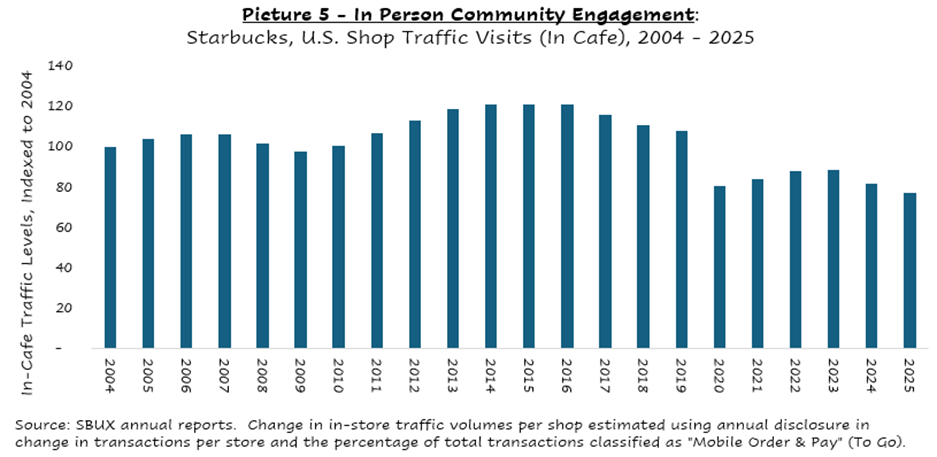
With the benefit of hindsight, it was the iPhone and Instagram that drained all the good fuel out of Starbuck’s third place growth tank. The in-person transaction volumes per U.S. shop – the best proxy for the third place strategy – are down about 25% in the last two decades. While the mission died, the equity story did not end. Starbucks found new fuel. Its stock has still outperformed the S&P 500 since mid-2007 (it’s up ~6x compared to the S&P 500 up ~3.5x).
Starbucks has delivered for shareholders for the past 20 years in spite of its third place roots, not because of them. The Board and executive team fought hard for the shareholders; they figured out new ways to extend the brand to make more money. They built a functional mobile app: now over 30% of orders are to-go orders placed in the app. They added new non-coffee drinks and significant menu customization that helped to grow average revenue and profit per transaction. They added drive-through. And they took the brand overseas.
The third place is still the soul of Starbucks. Howard Schultz still waxes romantically about it. The new CEO Brian Niccol is attempting to revive it. Starbucks never intended to abandon it. They had to because the creative destruction of The Game forced them too.
That is the point - the Game is one of adaptation or death. Starbucks is still around and far more relevant than Oldenberg’s old haunts because it chose to adapt and fight back instead of only clinging to its roots and dying slowly.
Companies are in the business of self-preservation – not preservation. No one should be surprised when their values and business models respond to changes in The Game. Unless you are a purveyor of luxury goods carefully engineered for scarcity, guardianship-as-strategy is typically a death sentence in The Game of Capitalism.
If the third place was both central and useful to Schultz and the Starbucks origin story, it was out of sight, out of mind for Mark Zuckerberg when he invented Facebook in 2004.
Zuckerberg built the original website to network college campuses, not solve social connection problems. As the website spread from college campuses to the world, Facebook became a network technology in search of a business model and a business in search of a mission. By the time of the IPO in 2012 the company was articulating a genuinely ambitious mission: to make the world more open and connected.
But it was not until Zuckerberg’s February 2017 “Building Global Community” manifesto that he really articulated a vision of Facebook as a digital third place:
There has been a striking decline in the important social infrastructure of local communities. Since the 1970s, membership in some local groups has declined by as much as one-quarter, cutting across all segments of the population… Online communities are a bright spot… developing [their] infrastructure will strengthen these communities and enable completely new ones to form
It is a matter of judgment whether Zuckerberg was really convicted in “Facebook as the digital third place infrastructure” or just using the idea as a branding ploy after the controversial 2016 U.S. presidential election. But what has happened to Facebook’s product strategy and profitability in the eight years since is not. It is a record of historical fact – and one that rhymes with Starbucks’ fight against its own extinction.
By 2022 the “Building Global Community” vision was not only dormant – it was actively being phased out. The Game had recast Zuckerberg from breathless hunter to vulnerable hunted. With the rise of TikTok young people were increasingly spending their smartphone time watching short video clips from strangers instead of posting public messages to friends. “Social media” was evolving into “short form entertainment.” It was adapt or die time for Facebook. So Zuckerberg did what great CEOs do – he fought like hell to stay alive. He leaned hard into Facebook’s TikTok copycat product (Reels) and increasingly served consumers content from a new artificial intelligence algorithm instead of posts from the friends and family members in their network or “social graph”:
“We're also seeing a major shift in feeds from being almost exclusively curated by your social graph to now having more of your feed recommended by AI, even if the content wasn't posted by a friend or someone you follow”
~ Q1 2022 Earnings Call (April 17, 2022)
Investors viewed the shift as existential for Facebook; the stock dropped 70% in 2022 as the company worked through it. But it worked. It turns out that AI-generated content not only keeps consumers in the app longer, but that it also creates much more valuable advertising inventory. Facebook’s annual advertising revenue per user is up ~50% (from ~$200 to ~$300) since the 2022 strategy pivot away from its social network roots.
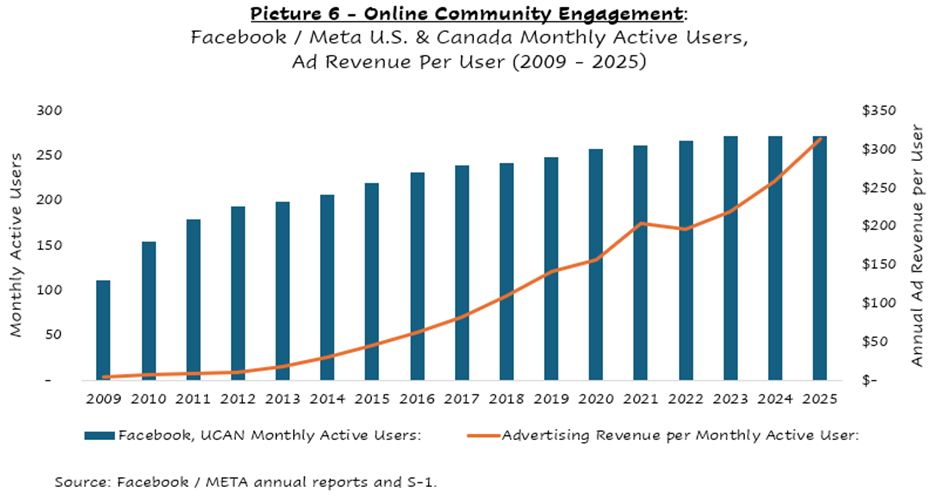
That’s the fifty year arc of the third place: from my parents drinking cheap draft beer at local taverns as a teenage couple in the 1970s to me and my high school friends buying CDs and more expensive drinks at Starbucks. To millions of little businesses placing ads around our online Facebook posts to each other through college – and then realizing that they were more effective than any ad before them at generating new demand. To this generation of youngsters scrolling alone, getting served up even more effective ads while watching Reels, TikTok and YouTube short clips from aspirational strangers.
In this third place mutation from a shared messy space to a private bazaar run on an algorithm, the encroachment of The Latticework has been breathtakingly effective. The commerce has gotten wildly better. Consumers have way more and better product choices. Facebook’s ad business produced $102B of operating profit last year. That compares to $3B of operating profit for Starbucks (down from a peak of $6B).
The Foundation? The U.S. Surgeon General declared a loneliness epidemic in 2023. Daily time spent in person with friends is down more than 50% in the past two decades, (from an hour minutes to 26 minutes). The surgeon general’s epidemic announcement blamed COVID. But the American Time Use Survey shows that the steepest pace of decline began years before – around when Starbucks’ in-person visits peaked.[2] That’s not the pandemic – it’s the Encroachment Problem of the Game at work.
[Dating & Family Formation]
The adaptation story of the third place: from social connection mediated through friendly commerce to completely strip mined in pursuit of ever more optimized commerce that has been enabled by technological change.
The evolution story of marriage and the family is also a story of consequential technological change – intended and unintended.
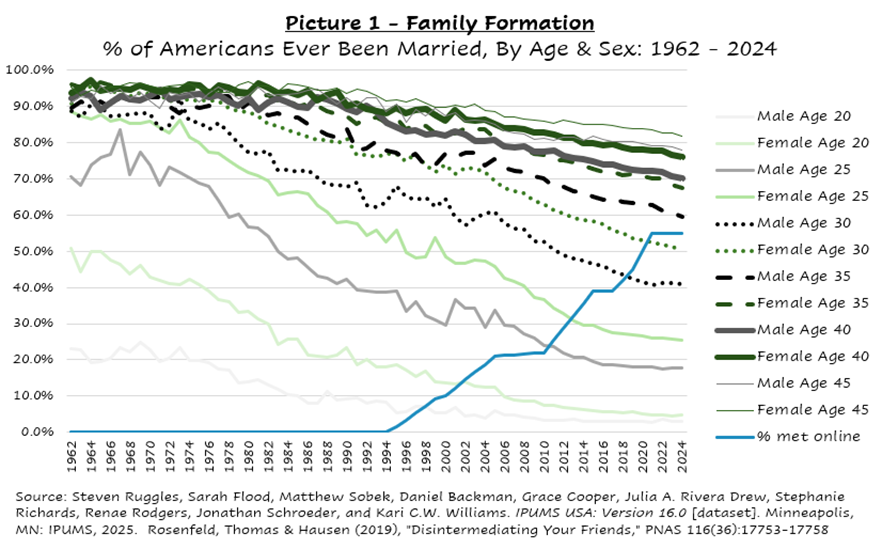
Marriage participation was already on a steady downward drift from the mid-1970s, well before the online dating business was born – especially for younger Americans. Despite declining marriage participation female fertility essentially held flat from 1973 (the year Roe v. Wade was passed) through 2000. Falling births within marriage were offset by more out-of-wedlock births. The nuclear family had already settled into a long slide by the time the dating industry was born. The dating industry offered hope as a solution to the stagnation. Algorithms on personality tests promised the potential of more effective matching than messy real life encounters in bars, churches, schools, or through friends.
It turns out that online dating sites executed against the business opportunity but worsened the problem they ostensibly set out to solve. They succeeded wildly at folding the coupling process inside a transaction: the percentage of heterosexual couples that meet online has risen from ~10% 2000 to 20% in 2007 to ~55% as of the mid-2020s. As the business of dating took share of coupling, the decline in marriage participation accelerated first with the rise of the internet (1995) and again with the launch of the iPhone.
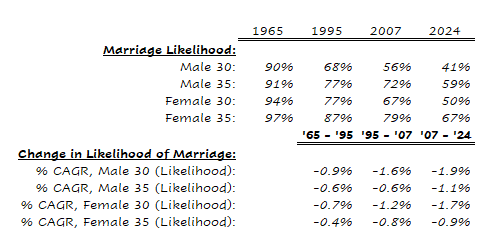
Most evidence suggests that quality (relationship satisfaction) has stayed constant. “Met online” marriages tend to have similar divorce rates to marriages that begin in the real world.[3] But volume (coupling) has fallen indisputably – fewer people than ever are getting married and the decline acceleration coincides with the rise of the internet and the dating apps.
With the benefit of hindsight, fewer permanent couplings look more like a feature than a bug in the business of dating. The worst (least profitable) customers for the dating companies are the ones that find soulmates quickly and never come back. The best (profit maximizing) customers are the ones in perpetual search: the weary wafflers and the swiping sex addicts. That the dating apps produced more of the latter categories should come as no surprise; they are what the business model (the game design) calls for.
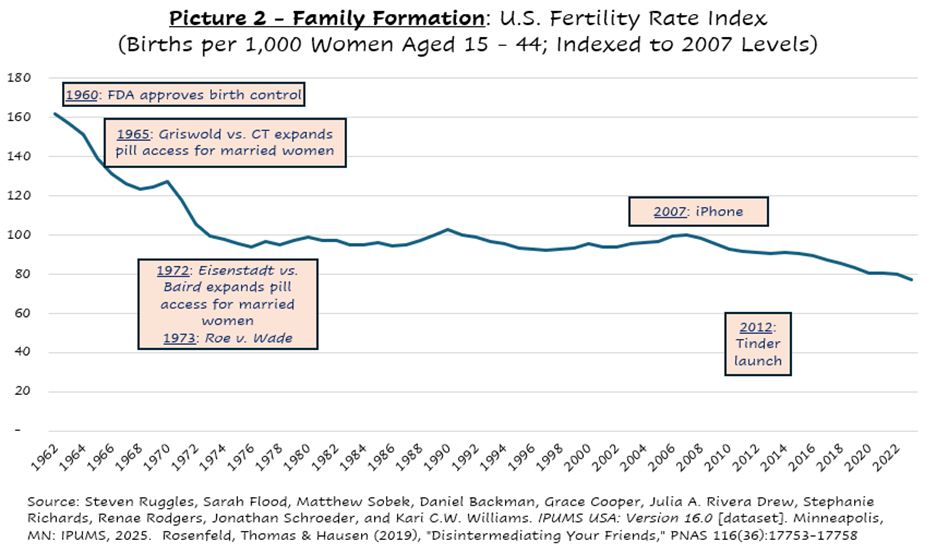
Regarding fertility – the downstream impact of fewer marriages has been fewer kids. The fertility rate held close to flat for forty years after the passage of Roe v. Wade but is down over 20% since the launch of the iPhone. The out-of-wedlock birthrate has been roughly flat since 2007. Virtually all of the decline in childbearing has come from fewer marriages. The dating industry did not set out to curtail fertility, but the data suggest that its impact may be on a similar scale to that of the lynchpin Supreme Court case of the culture wars.
The Game of Dating is a victim of its own design – it is another story of the Latticework eating through The Foundation. It hollowed out the next generation of marriages and families by aggressively chasing strategies that signaled positive first order effects (rising user engagement) but that hid negative second order effects (alienated users).
The nuance compared to the third place adaptation story is that the dating industry also drained its own profit pool. The dating game has run out of fuel. After a sugar high of engagement during the COVID pandemic virtually all of the dating apps focused on heterosexual coupling hit user growth saturation points shortly after the world re-opened. Many hopeful daters have given up on the online dating game, convinced that finding a committed match is too hard and not worth it. Ordinary guys struggle to get matches; they get crowded out of the game. Attractive women have endless options to “play the field.” There always seems to be patch of field where the grass looks greener. Marriage rates are roughly 20% lower for “prime age” (30-35) males and females than they were 20 years ago.
The moral of the dating apps story is not that they are evil companies that set out to erode marriage. It’s that, through a decentralized trial-and-error process, one of them stumbled upon a product feature (“swipe right”) that was great for the business model. Once discovered, the feature was naturally pursued to its logical endgame. The Tinder product management team did not stop and consider any potential delayed second order effects that this form of courtship would have. Why would they have? All the signal from the “swipe right” product feature suggested that its effect was positive, immediate, and offered a path to riches. Naturally, Tinder doubled down on it.
The strategic response to “Swipe Right” was exactly what The Law of The Game would have predicted. When a business gets positive, legal, high signal feedback or information about its products – it generally uses that signal to make as much money as possible. The chasing of profit signal is core to the creative destruction process. It is what The Game runs on.
In most markets the chasing of and execution against this signal leads to steady quality improvements and value for consumers. Examples abound: the camera-less smart phone died once the iPhone was invented. Commercial buildings accelerated upgrade cycles once LED lighting proved more cost effective than incandescent bulbs. Incandescent bulbs are hardly made anymore. In these product feature shifts, the benefits to the end users were immediate and obvious.
The story of the “Swipe Right” feature upgrade is different because it did not just improve upon or invent a new economic transaction. It fundamentally reshaped courtship, marriage and family formation – social institutions that for centuries have played critical roles in human and social development beyond the marketplace. Few relationships require the trust and capacity for forgiveness that a marriage does. Few roles teach selflessness as relentlessly as parenting. These are the roles that for centuries have transformed Foundational Values from abstract platitudes into convicted lived beliefs. So we should not be surprised to see conviction wane as the design of The Game’s strategic engineering routes people out of these roles.
Wisdom is slow, messy and anti-fragile. Information is fast and efficient – but it can be fragile. Markets run on information; the transaction chases the signal. In the economization of courtship, information got prioritized over wisdom. The Latticework of the dating game ate the Foundation of marriage. Dating behavior had already been rewired by the time anyone realized what had happened. It is too late to un-swipe. There is no going home again.
[Faith & Transcendence]
In adapting the third place and marriage to its design The Game advanced by running The Latticework right through the Foundation. New business models re-engineered those spheres directly through new types of transactions. In the case of religious life the Game’s strategy has been different: to outflank, not run through. To trace why the outflanking strategy was called upon – we must first travel back 500 years.
“As soon as the coin in the coffer rings, the rescued soul to heaven springs.”
~ Fr. Johann Tetzel (1517)
In the summer of 1517, an old Dominican friar Johann Tetzel was travelling around Germany selling indulgences to faithful laypeople. He had been tasked with securing the funds for the reconstruction of Saint Peter’s basilica in Rome – and to pay off the political debts of his Archbishop. The above couplet is the marketing slogan he used with great effect to catalyze transactions for salvation.
On October 31 – the eve of All Saints Day – a 33 year old Augustinian friar posted his 95 Theses on the door of The Castle Church in Wittenberg. Martin Luther was outraged that his parishioners were travelling to nearby provinces to buy indulgences from Tetzel. (Indulgences had been banned in Luther’s province).
Luther was aggrieved by the indulgences campaign, but no revolutionary – he aspired to initiate reform from within. He wrote the 95 Theses in Latin, the language of academic and theological dispute, because he intended for the document to travel only within the clerical and scholarly sphere. Instead, someone took his 95 Theses, translated them into German and took them to a printing press. By that point, the 95 Theses were riding a runaway train of creative destruction via technological change that Luther neither anticipated nor intended. Commercial presses printed what sold – and the 95 Theses sold better than almost anything. Merchants carried the 95 Theses across Germany’s trade routes. It reached Rome within a month; England and France within two.
Luther was excommunicated by Rome within four years of publishing his theses. He had exposed the inconvenient truth: that faith mediated through transaction is not grace. It is grift. That you cannot take people to The Cross through logic of The Game – that the journey collapses on itself under the weight of The Encroachment Problem.
It took the Church nearly another half a century to formally ban indulgences. Luther watched with horror for the rest of his life as his Church became increasingly fractured and sectarian. His 95 Theses had catalyzed a reformation he never wanted, breaking his church and his own heart.
In the temple he found those who were selling oxen and sheep and pigeons, and the money-changers sitting there. And making a whip of cords, he drove them all out of the temple, with the sheep and oxen. And he poured out the coins of the money-changers and overturned their tables. He told those who sold the pigeons, “Take these things away; do not make my Father's house a house of trade.”
~ John 2:14-16
There is a poignancy to the story of Luther and The Reformation. The Cleansing of The Temples – quoted above from John’s Gospel – is one of only a handful of moments of his life preceding The Passion and Resurrection story that appear in all four gospels. It arguably the moment in The New Testament when Christ shows the most visible anger. Christ was deeply offended by The Encroachment Problem. It is tragic and telling that it would reappear as the catalyst to fracture his church on earth.
The indulgences offended so deeply because they violated the most sacred and central truth of Christian divine love: that it is non-contingent. It is freely available to us. We can squander it – but it is not “ours.” There nothing we did to deserve it in the first place. That truth cannot be folded into a quid-pro-quo transaction without combusting.
This relational leap from quid-pro-quo to unconditional gift is what separates faith and religious life from the other guardian spheres. It is why churches have never charged for attendance, why indulgences were existential, and why the patronage model and voluntary donations have survived as a means to fund and sustain the Church. The patronage model brings its own messy human power dynamics but comes closer than any other option to approximating the non-contingency of divine love.
Truly accepting this unconditional gift seems deeply unnatural to the world of human affairs. It is also the heart of Christian revelation: all vitality and authenticity in religious life sit downstream of it. We can’t method act our way to accepting the gift just by showing up.
In active religious life there is a chasm between Showing Up and Being There. To show up is to be aware of and respect the gift – to be there is to accept it. The chasm between them is revelation. It is crossed through grace alone. The uncomfortable truth is that which side you are on is everything. I know from too much experience – when you are just showing up, you are actually still closer to The Game than The Cross.
Grace is supernatural. It is not governed by natural law or even the patterns of human behavior. We cannot engineer it into existence – but we can suffocate it to the point where it has no room to breathe its life into us. The hidden genius of the Sabbath that Tocqueville observed in American life two hundred years ago was that it preserved space in the calendar for the mystery of grace to breathe. So it maximized the likelihood that the congregants would not just show up to church on Sunday. But would actually be there.
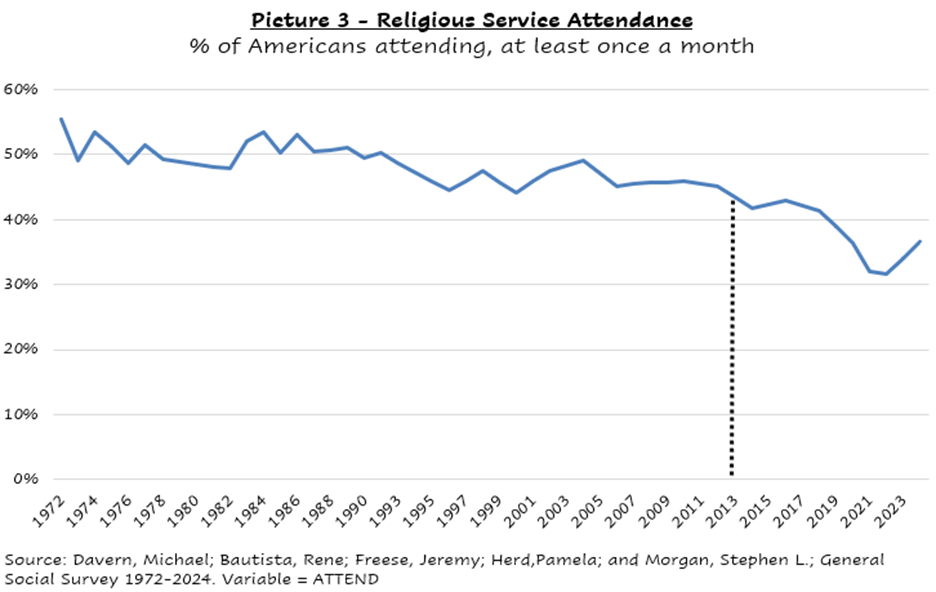
The chart below captures time series data on the percentage of Americans showing up for church: down 35-40% in the fifty-odd years from 1972. There is no time series on being there. But my hunch, informed from experience, is that it has suffered a much faster slope of decay.
The jangles of Father Tetzel’s coins still echo faintly through modern faith culture: from the conceit of Joel Osteen’s prosperity gospel to the grift of Ballerina Farm’s $26 cinnamon rolls, to countless other unnamed places. But those echoes are not really the modern story of The Game’s strategic adaptation in our search for transcendence.
The real story is that we have conceded the search through distraction – distractions abetted by The Game. The ever-elongating NFL season. Youth sports. Soul Cycle. The Wellness Economy. Each one seems harmless in isolation – fun, and perhaps even good. Each in its own way simulates and compensates for a sliver of what the communal search for true transcendence seeks. And so we have hardly even noticed that, for decades, our Sundays have been increasingly cluttered with new rituals and commitments that silently encroach on the emptiness that grace requires to manifest.
“There is a crack in everything. That’s how the light gets in”
~ Leonard Cohen, “Anthem” (1992)
The crack is everything in the pursuit of the divine. But The Game abhors a vacuum. That is the entire point of the outflanking strategy: money rushes in where angels no longer tread.
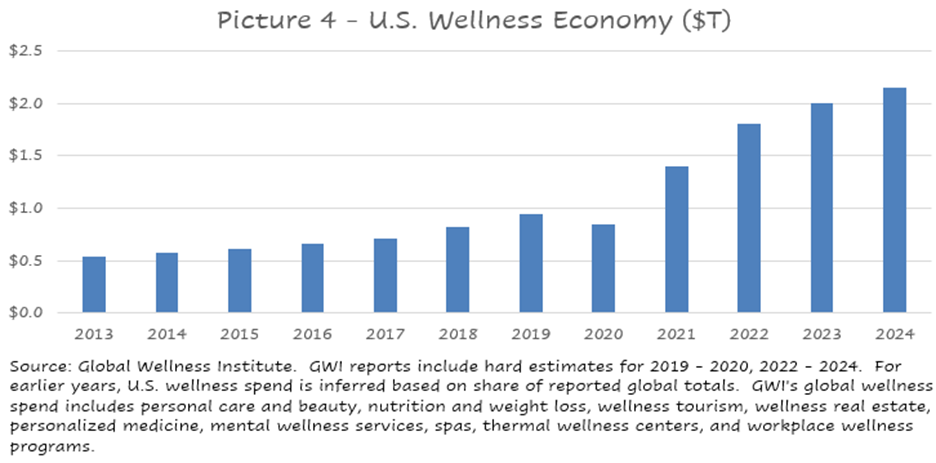
The average NFL franchise was worth approximately $420 million in 2000.[4] Average NFL franchise value in 2025: $7.13 billion. [5] That's a 17x increase per franchise in 25 years: value has compounded at 11-12% per year versus the S&P 500's roughly 7% since 2000. 72 of the 100 most watched American telecasts in 2024 were NFL games.[6] Americans wagered $150 billion legally on sports last year – eleven times the 2019 figure – with $35 billion on the NFL season alone.[7] California and Texas have not even legalized yet.
The point is not to wag a finger in your face. It is not bad to attend fitness classes or watch NFL games. The runner’s high is real and incredible. The NFL is fun: with its tribal loyalty, shared suffering, and redemptive glories, it proxies the communal experience of transcendence surprisingly well. But it is a simulacrum, not the experience – and it monetizes the simulacrum at every possible layer: the media rights, the ticket, the merchandise, the fantasy league, the bet. The Game didn't kill Sunday ritual. It turned Sunday ritual into the most profitable entertainment product in human history by layering a cascade of financial transactions on top of the emotional experience of watching it.
[Michelangelo’s Hauntings]
No one wrestled with the dialectic between The Game and The Cross like Michelangelo did.
Construction of the new Saint Peter’s Basilica was completed in 1626 – more than a century after Tetzel’s indulgence campaign that funded the project and fractured the Church.
Saint Peter’s Basilica is not the mother church of Catholicism – that title belongs to the older Lateran Basilica. But it is the world’s most iconic church and serves as the backdrop for every papal mass of global significance. It has a larger interior than any other church and is home to an unrivaled concentration of Christian artistic masterpieces: including Michelangelo’s La Pieta. It is the destination of one of the most important Christian pilgrimages, The Jubilee pilgrimage, that the faithful have been partaking in for seven centuries.

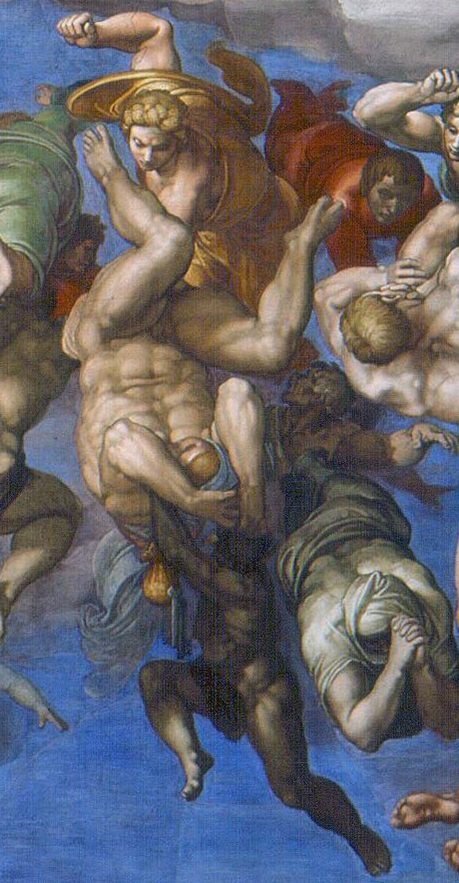
The Sistine Chapel sits adjacent to Saint Peter’s Basilica; they are a two minute walk from each other. The Last Judgement was the final large-scale painting that Michelangelo completed in The Sistine Chapel. He unveiled it on October 31, 1541: 25 years to the day after Luther posted his 95 Theses to the door of The Castle Church in Wittenberg.
The Last Judgement is a very different masterpiece than Dante’s Divine Comedy. Michelangelo does not excruciatingly label the typical sins of the damned as Dante did. He makes one exception: the figure upside down in the bottom right portion of The Last Judgement. He is being pulled down by demons towards Charon’s Boat and the mouth of hell. From his waist dangle two keys – a reference to Peter’s two keys to the church – and a moneybag. Look at the painting. Then close your eyes and imagine Tetzel’s coins inside.
Michelangelo was haunted by The Encroachment Problem. So much so that he spent his final years designing the dome of Saint Peter’s Basilica for free — refusing payment for the greatest commission in Christendom.
[Restoring The Foundation]
The point of the story of Tetzel, Luther, Michelangelo and Saint Peter’s Basilica is not to condemn commerce. Decentralized cooperative trade is the heartbeat of the free market process that has compounded global real GDP per capita more than tenfold since 1800.[8] It is also one of the defining sociological behaviors that separates humans from other mammals. Commerce – fundamentally the pursuit of wealth, or material enrichment – has been very, very good to humanity since the Industrial Revolution.
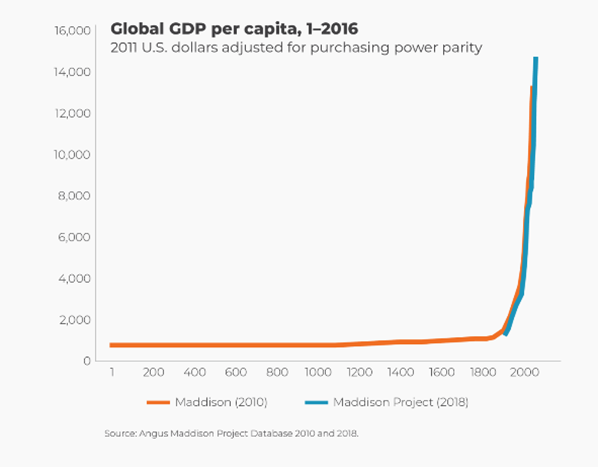
The subtler aspiration of this essay, along with The Game of Capitalism, is to establish that the relationship between wealth compounding and human flourishing is not straightforward. The marketplace and the ethics that underpin it interact in a complex dialectic that is severely under-explored in our modern discourse on wealth, technology, and politics.
The commercial cycle reinforces the foundational ethics that underpin it: through the hard work it demands of us, through the trust-building mutually beneficial transactions that it engenders, and by empowering individuals to freely pursue their own creative pursuits. It nurtures the seeds of human potential and captures the harvest.
But The Encroachment Problem is also real: the commercial cycle can tend to erode its own underpinning ethics through its own insatiable logic.
The self-serving conceit of deterministic socialism is that The Encroachment Problem is a fatal design flaw in The Game of Capitalism. Its modern avatars falsely proclaim that the whole lot must be overhauled – not just The Game, but The Foundation too – with the referee getting an ever bigger role in the demolition.
The self-serving conceit of techno-optimist libertarianism is to pretend that The Encroachment Problem does not exist. Its modern avatars falsely relegate it to a perfunctory technicality – and then patronize us with fallacies that it can live safely in an unexplored clause of a manifesto that serves their own ends.
The truth is that The Encroachment Problem is a thorny, chronic execution problem that the game design has never solved for. Not in America or anywhere else. Chronic problems are easy to name, hard to diagnose, and even harder to cure. Chronic health problems can be managed with exogenous fixes (pills and medicine) but rarely truly fixed without consistent, slow internal effort. The Encroachment Problem is no different.
Christ did not condemn commerce. But he was acutely aware of The Encroachment Problem. His warnings about it appear all over the Gospels. The good news is that so are the blueprints for dealing with it.
Ask, and it will be given to you; seek, and you will find; knock, and it will be opened to you. For every one who asks receives, and he who seeks finds, and to him who knocks it will be opened. Or what man of you, if his son asks him for bread, will give him a serpent? Or if he asks for a fish, will give him a stone? If you then, who are evil, know how to give good gifts to your children, how much more will your Father who is in heaven give good things to those who ask him? So whatever you wish that men would do to you, do so to them: for this is the law and the prophets.
~Matthew 7:7
It is telling that in Matthew’s recounting of The Sermon on the Mount Christ builds to the Golden Rule through the example of parenthood. Parental love is the closest proxy of divine benevolence in the entire spectrum of human-to-human relationships. It is the natural path on which The Golden Rule can evolve from empty platitude to convicted, lived belief. That conviction is our single best defense against The Encroachment Problem.
As you wish that men would do to you, do so unto them. If you love those that love you, what credit is that to you? For sinners love those who love them. And if you do good to those who do good to you, what credit is that to you? For even sinners do the same. And if you lend to those from whom you hope to receive, what credit is that to you? Even sinners lend to sinners, to receive as much again. But love your enemies, do good, and lend, expecting nothing in return; your reward will be great.
~ Luke 6:31-35
In Luke’s articulation of the Sermon on The Plain, Christ extends The Golden Rule to its edge case: our enemies. He is effectively engaging with the modern argument that “capitalism is how we take care of people we don’t know”[9] – through quid pro quo transactions. Clearly Christ has no issues with the logic. But he doesn’t pull any punches – he is not entirely impressed by it either. His Foundation demands more of us than the quid pro quo that The Game runs on.
No one can serve two masters; for either he will hate one and love the other, or he will be devoted to one and despise the other. You cannot serve God and mammon.
~ Matthew 6:24
And Jesus entered the temple of God and drove out all who sold and bought in the temple, and his overturned the tables of the money changers and the seats of those who sold pigeons. He said to them, “It is written, ‘My house shall be called a house of prayer’ – but you make it a den of robbers.”
~ Matthew 21:12
Christ does not disparage Mammon. But when it encroaches upon the sanctity of his father’s house, he flips out. He starts turning over tables. His rage is a tell of the seriousness of The Encroachment Problem. When the logic of The Game is no longer subservient to a higher logic, it transforms from a very useful game to harmful grift.
Teacher, we know that you are true, and teach the way of God truthfully, and care for no man; for you do not regard the position of men. Tell us, then, what you think. Is it lawful to pay taxes to Caesar, or not? But Jesus, aware of their malice, said “Why do you put me to the test, you hypocrites? Show me the money for the tax.” And they brought him a coin. And Jesus said to them, “Whose likeness and inscription is this?” They said, “Caesar’s.” Then he said to them, “Render therefore to Caesar the things that are Caesar’s and to God the things that are God’s.” When they heard it, they marveled; and then they left him and went away.
~ Matthew 22:15-22
Here, the Jewish religious leaders of his time try to bait Christ into choosing between religious law and the law of money and commerce. But, with some theatrical flair and a killer one liner, he threads the needle. They have no rebuttal and leave him be.
The entire blueprint for dealing with The Encroachment Problem is contained in the excerpts from above. You need not even entertain Jesus as divinity to engage meaningfully with these specific suggestions as solutions. But you probably do need to see in the human experience more than simply the material. Without a flicker of belief in the transcendent, it is hard to see The Golden Rule as true and worthy of what it demands of us – not just an illusion that becomes incredibly useful if enough people buy into it.
There is a chasm between seeing the truth and seeing a useful illusion. Perhaps the bridge to crossing that chasm is grace. Perhaps the first step towards restoring the foundation is creating the space that the bridge requires to manifest.
What are you doing next Sunday?
[1] Warren Buffet’s final letter to Berkshire Hathaway shareholders, in which he announced CEO succession to Greg Abel. (Microsoft Word - Gift_Press_Release_11-10-25.docx).
[2] The ATUS has run continuously since 2003. It asks a nationally representative sample of Americans to walk through every minute of the previous day in a detailed time diary — what they were doing, where they were, and critically, who they were with. "Socializing and communicating" is a specific activity category. The "with whom" field is what generates the friend/family/alone breakdowns.
[3] There have been five major academic studies on the topic of “marriage quality” by relationship origin. The summary is that quality (usually measured by break-up rates) is similar for online and offline. Some studies have found online marriages are slightly less likely to lead to divorce, others have found the opposite. No study has produced a strong effect in either direction.
[4] Forbes, per secondary sources citing it.
[5] Sportico NFL Franchise Valuation Rankings. NFL Team Values Ranking List
[6] Nielsen data cited by CNBC. (CNBC's Official NFL Team Valuations 2025)
[7] Data from the American Gaming Association as cited by Covers. (2024 AGA Report Underscores Legal Sports Betting Market Growth)
[8] (Global Income Is Rising - Human Progress). Based on the work of Dutch economic historian Angus Maddison.
[9] (https://a16z.com/its-time-to-build/)
Member discussion